








Popular searches:
EB-S1
S90
MNK6
EB-S1E
How to Choose a LUYUAN Electric Scooter for City Commuting


Aug 27,2026
City commuting puts different demands on an electric scooter than recreational riding. A daily commuter may deal with traffic, potholes, speed bumps, wet roads, slopes, frequent stops, and relatively long periods in the saddle. Choosing the right model therefore requires looking beyond maximum speed or battery capacity.
For riders and distributors evaluating urban mobility products, comfort, controllability, stability, and adaptable power delivery can be more important than headline performance. LUYUAN’s driving-control approach provides a useful framework for understanding which features deserve attention when selecting an electric scooter for everyday city travel.

Start With Your Daily Commuting Conditions
Before choosing a model, consider the actual route rather than selecting a scooter based only on its appearance. A short trip on smooth city streets may require different characteristics from a longer commute involving uneven pavement, hills, or changing weather.
Think about your typical distance, road surface, traffic density, parking situation, and riding frequency. If you commute every weekday, features that reduce physical strain and make the vehicle easier to control can have a meaningful effect on your overall experience.
This approach also helps buyers compare models more logically. Instead of asking which scooter has the highest specification, ask which configuration best matches the roads and riding conditions you encounter most often.
Look for a Comfortable Electric Scooter With Good Ergonomics
Riding comfort is important when a scooter becomes part of a daily routine. Seat shape, support, suspension, riding posture, and foot placement can all influence how tiring a journey feels.
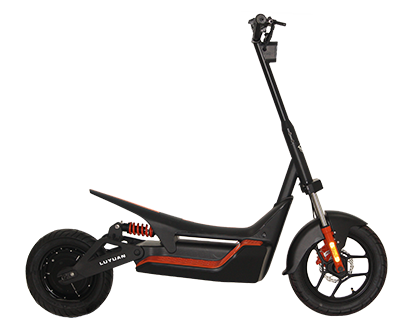
LUYUAN’s driving-control system highlights an ergonomic saddle using zoned support and high-elastic memory foam. The structure is designed to conform to the rider and distribute pressure, supporting greater comfort during longer rides.
This is particularly relevant for commuters who spend substantial time seated. When comparing a comfortable electric scooter, buyers should consider how the seating position feels during an actual ride rather than judging comfort from appearance alone.
Check Suspension for Urban Road Conditions
Urban roads are rarely perfectly smooth. Potholes, uneven pavement, drainage covers, and speed bumps can introduce repeated impacts, especially when commuting every day.
LUYUAN’s driving-control information describes a front and rear dual hydraulic sports shock absorption system, with a five-level adjustable rear shock. The system is designed to filter bumps while supporting a smoother and more stable ride.
For city commuting, suspension should therefore be considered alongside seat comfort. A supportive saddle can reduce pressure on the rider, while suitable suspension helps manage the road surface underneath the vehicle.
Consider How Power Modes Match Your Route
Power delivery is another factor that can affect urban usability. A commuter may not need maximum output throughout the entire journey. Different road conditions may call for different levels of acceleration and power consumption.
The driving-control system lists three modes with five-level adjustment for e-scooter models. These settings are intended to balance range and output while allowing riders to switch modes according to their needs.
When evaluating an electric scooter, consider whether its power settings are practical for your route. Lower output may be useful in some everyday situations, while stronger assistance can be helpful when conditions require additional acceleration.
Pay Attention to Wet-Weather Stability
Rain can change road grip and make cornering more demanding. This makes traction management an important consideration for riders who commute throughout the year rather than only in dry weather.
Our TCS anti-skid function is designed for rain or snow conditions. One-touch activation adjusts power to help prevent wheel slip and improve stability during turns.
A feature like this does not eliminate the need for cautious riding. Instead, it can form part of a broader control system designed to make the scooter more predictable when road conditions become less favorable.
Think About Hills and Descents
Not every city commute is flat. Routes may include parking ramps, bridges, steep streets, or extended downhill sections. Riders should therefore consider how the scooter behaves when moving between different elevations.
The driving-control system includes HDC and HSA functions. HDC is described as using high-frequency light braking to help maintain a low speed during steep descents, while HSA is designed to help maintain stability on slopes and prevent rolling.
For daily commuting, these functions can be useful considerations when comparing scooters intended for routes with frequent inclines or declines. Buyers should still check the applicable specifications and local requirements for each model.
Match the Model to Your Local Requirements
The best scooter for commuting is also one that fits the regulations and infrastructure of the market where it will be used. Speed limits, vehicle classifications, licensing requirements, helmet rules, and permitted road types can differ by location.
For consumers, this means comparing the actual configuration rather than assuming that every model in a product family has identical specifications. For e-scooter suppliers, it also provides a basis for matching different products with the requirements of specific markets.
What Should E-Scooter Suppliers Consider?
For businesses selecting products for a city-focused lineup, the same principles can guide procurement. An e-scooter supplier should be evaluated not only on vehicle performance but also on how its product technologies address everyday riding conditions.
Distributors can examine ergonomic design, suspension, power adjustment, traction management, slope control, and available model configurations. They should also confirm the technical specifications, certifications, and market suitability of the exact version being considered before placing an order.
A product range that covers different commuting needs can give distributors more flexibility. LUYUAN's current comparison platform shows multiple e-scooter models across performance and standard categories, giving buyers several configurations to assess for different urban markets.
Choose for the Journey You Actually Ride
Selecting a city scooter should begin with the rider’s real routine. Consider road quality, commute length, hills, weather, comfort, and the level of control required in traffic. These factors can reveal which features matter more than a simple comparison of speed or range.
For riders looking for a comfortable electric scooter, ergonomic seating and effective suspension deserve close attention. Power modes, traction management, and slope-control functions can also contribute to a more controlled urban experience.
For distributors working with e-scooter suppliers, understanding these user priorities can make product selection more precise. Rather than choosing a model solely from a specification sheet, evaluate how its driving-control features correspond to the conditions customers face every day.
A detailed review of the available models and their configurations is the logical next step. By matching product characteristics with real commuting scenarios, buyers can make a more informed choice and identify an electric scooter that fits both the rider and the city in which it will be used.




Press: media@luyuan.cn
Telephone: +86-579-82272946
Business: market@luyuan.cn
Telephone: +86-579-82272528
Service: service@luyuangroup.com
Select your country or region
Global
Asia

中文