








Popular searches:
EB-S1
S90
MNK6
EB-S1E
Why Long-Range Electric Scooters Matter to Riders in 2026


Aug 24,2026
Urban mobility is changing as riders look for transportation that can cover more ground without frequent charging. In 2026, range has become an increasingly important consideration for commuters, delivery users, and riders who regularly travel across large urban areas.
A 120 km range electric scooter represents an appealing benchmark for these users, but buyers should look beyond a single advertised number. At LUYUAN, we recognize that battery technology, riding conditions, motor efficiency, charging time, and vehicle design all contribute to the actual riding experience. The S70 Pro provides an example of how manufacturers can respond to the growing demand for longer-range electric mobility.

Why Long Range Matters More in Modern Cities
Daily urban travel is rarely limited to one fixed route. A commuter may travel to work, stop for groceries, visit another location, and return home without having an opportunity to recharge.
Longer available range gives riders more freedom to make these additional trips. It can also reduce charging frequency, which is particularly useful for people who rely on an electric scooter as their primary daily transportation.
For this reason, a long-range electric scooter should be evaluated according to the rider's complete travel pattern rather than only the distance between two points.
Is 120 km the New Range Benchmark?
The phrase 120 km range electric scooter can attract attention because it provides a simple way to describe long-distance capability. However, buyers should be careful when comparing range claims from different manufacturers.
Range testing can involve different speeds, loads, temperatures, road surfaces, and battery configurations. A published figure should therefore be treated as a test result under specified conditions rather than a universal promise.
The S70 Pro Takes a Different Approach
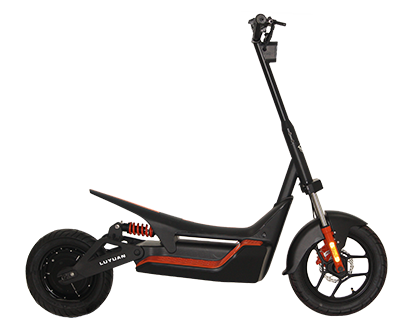
Rather than presenting the S70 Pro simply around a maximum-distance figure, its product design combines battery capacity with motor performance, thermal management, comfort, and road-control features.
The highest S70 Pro-GT configuration has a 2,000 W rated motor, a 70 km/h maximum speed, and a listed 14˚ climbing capacity. It uses a 76 V 27 Ah LFP battery and a 6A charger, with an approximately 5 to 6 hour charging time.
This makes the model relevant to the wider long-range trend without incorrectly positioning it as a 120 km-rated vehicle.
Battery Technology Is Changing
As range expectations increase, battery technology becomes more important. Larger capacity can provide more stored energy, but battery chemistry, thermal management, charging behavior, and battery protection also affect long-term usability.
The S70 Pro's technology section includes both high-energy graphene and super lithium battery solutions. Its super lithium battery information highlights lithium manganese iron phosphate materials and long service life.
This reflects a broader industry direction in which manufacturers are paying greater attention to the complete battery system rather than treating capacity as the only measurement of battery performance.
Thermal Management Supports Consistent Performance
Longer journeys can place greater demands on the motor. Continuous operation, high ambient temperatures, and demanding road conditions can increase heat generation, making thermal management an important engineering consideration.
The LUYUAN S70 Pro uses Liquid-cooled Motor 2.0. Our graphene-coated end shield is designed to improve heat transfer while enhancing water and corrosion resistance. The motor also uses automotive-grade insulation.
For riders, this technology matters because long-distance performance depends on how the complete power system behaves during extended use.
Comfort Becomes More Important as Range Increases
A longer-range scooter is only useful if riders can comfortably spend more time on it. As daily travel distances increase, seating position, foot space, suspension, and passenger support become increasingly relevant.
The S70 Pro includes an ergonomic comfort seat and oversized footboard. Its suspension combines an aluminum-cylinder hydraulic system at the front with spring hydraulic suspension at the rear. The model also has front and rear disc brakes.
These features show how long-distance product development can extend beyond battery capacity into the physical experience of riding.
Long-Range Performance Needs Road Stability
Urban roads can present potholes, uneven surfaces, traffic interruptions, and sudden changes in speed. A scooter intended for extended travel therefore needs appropriate tires, suspension, and braking systems.
The S70 Pro uses graphene steel wire tubeless tires with a self-sealing layer. This technology reduces the chance of air leakage by 50%. Its solid-state controller is also specified with IP67 dust and water protection and shock resistance.
For everyday riders, these supporting technologies can be just as important as the battery when evaluating a long-distance vehicle.
What the 2026 Industry Trend Shows
Range is becoming only one part of a larger competition in electric mobility. Recent industry developments are placing greater attention on intelligent systems, battery management, connected functions, and overall riding scenarios.
In May 2026, we announced a shift from product export toward capability and ecosystem development at our global partner conference. We also introduced a product strategy centered on new materials, new intelligence, and new lifestyles.
This suggests that future long-range electric scooters may increasingly compete through complete user experiences rather than battery capacity alone.
Why Manufacturers Need More Than Bigger Batteries
For electric scooter manufacturer in China , meeting growing range expectations requires cooperation between battery engineering, motor development, vehicle design, and manufacturing quality.
A larger battery can increase vehicle weight and charging requirements. Manufacturers therefore need to balance energy capacity with handling, packaging, thermal management, and overall usability.
This is where engineering experience becomes important. Buyers evaluating a Chinese manufacturer should examine its development capabilities and testing infrastructure rather than assuming that a larger battery automatically produces a better product.
A Real-World Example of Range Testing
The S70 Pro also provides an example of why real-world testing matters. In March 2026, we reported an extreme-cold and high-altitude test for the S70 Pro on the Qinghai-Tibet Plateau at approximately 3,500 meters.
During the reported test, the S70 Pro achieved a single-charge range of 93 km at a constant 35 km/h under the stated test conditions. The report also described testing involving steep inclines and extreme cold.
This figure should not be confused with a standard everyday range guarantee, but it demonstrates how manufacturers can use demanding environments to evaluate long-distance performance.
What Should Buyers Look For?
For riders considering a long-range electric scooter, the first step is to identify actual daily distance. Next, examine battery capacity, charging time, motor output, terrain capability, comfort, and road-control equipment.
For B2B buyers, supplier evaluation should happen at the same time. An electric scooter manufacturer in China should be able to provide clear specifications, testing information, manufacturing capabilities, and appropriate support for the target market.
The S70 Pro offers a useful case study because it approaches long-range mobility through a combination of battery technology, liquid-cooled motor technology, suspension, tires, and comfort features rather than relying on an unverified headline range.
The Future of Long-Range Urban Riding
Longer range will remain important as electric scooters become more deeply integrated into daily transportation. However, the industry's direction suggests that range alone will not define the next generation of products.
Riders will increasingly expect a combination of usable battery capacity, efficient charging, stable power delivery, comfortable riding, intelligent battery management, and dependable construction.
For buyers comparing a 120 km range electric scooter, the most important lesson is to verify how the number was measured and whether it matches their real needs. For distributors evaluating an electric scooter manufacturer China partner, the deeper question is whether LUYUAN has the engineering and manufacturing capabilities to turn long-range ambitions into reliable products.
The S70 Pro demonstrates this broader approach, making it a relevant model to consider when examining how long-range electric mobility is developing in 2026.




Press: media@luyuan.cn
Telephone: +86-579-82272946
Business: market@luyuan.cn
Telephone: +86-579-82272528
Service: service@luyuangroup.com
Select your country or region
Global
Asia

中文