








Popular searches:
EB-S1
S90
MNK6
EB-S1E
Built for the Roughest Routes: The MKK Story


Jul 31,2026
A rough route asks several systems to work at once. Power must remain controllable, the tires must maintain contact, suspension must manage repeated impacts, brakes must perform reliably on the return descent, the battery must cover the distance, and the rider must remain composed. We use the LUYUAN electric scooter MKK-12 phrase only as the required search term.
The cited product specification names the family MKK and identifies MKK Pro-Li as the highest configuration behind the headline test. We keep model names, configurations, and supporting evidence clearly distinguished so that a URL, marketing phrase, product family, or specific trim is not mistakenly treated as interchangeable.
MKK's 80 km/h maximum, 90 km driving range, and 30-degree climb come from the top MKK Pro-Li test configuration, with the actual outcome varying by vehicle setup. These figures are relevant to demanding routes, but they do not replace legal review, payload limits, surface assessment, or a controlled trial.
We begin with the hardest segment rather than the average road. A short steep climb, loose-surface corner, repeated bump section, water crossing, or long descent may determine suitability. The route map should identify surface, gradient, length, speed, load, weather, stopping space, and recovery options.

Power and Climbing Define the Hardest Segment
Clear explanation of how rated power becomes usable force is part of the standard for an off-road electric scooter manufacturer. The highlighted MKK Pro-Li block reports a 5,200 W rated-power figure with the highest-configuration claim. Traction, controller calibration, battery voltage, thermal management, suspension, and rider input determine whether that power remains controllable on a climb.
The 30-degree result belongs to the MKK Pro-Li highest-configuration test. The evaluation should determine how gradient was defined and what surface, length, payload, battery state, temperature, tire pressure, and starting method applied. Without those conditions, the number cannot predict every hill or repeated ascent.
More power cannot recover grip that the tire has lost. Loose stone, mud, wet paint, sand, and broken pavement change contact quickly. Riders need smooth input, suitable speed, secure payload, and room to stop. For practical purposes, a route test should be conservative and remain within model instructions and local rules.
Climbing is only half the segment. The return test examines brake feel, repeated-descent heat, tire contact, suspension balance, steering, and safe parking on a slope. Any assistance feature must be confirmed for the exact trim and understood by the rider.
Range and Battery Define Whether the Route Is Repeatable
The all terrain electric scooter decision must include the complete out-and-back trip. The highest MKK Pro-Li configuration offers a driving range of up to 90 km, although actual performance varies depending on vehicle configuration and operating conditions. Dispatch needs a reserve for gradients, payload, surface, weather, detours, speed, and battery condition.
The highlighted configuration lists a 72 V 45 Ah NCM battery and five-to-six-hour charging time. Those values should remain tied to the displayed configuration and approved charger. The detailed table shows several MKK versions, reinforcing why the purchase order must identify the exact battery and motor.
For the MKK, we introduce Liquid-Cooled Motor 2.0 technology together with an intelligent BMS that supports smart-device communication, helping riders access a more connected and informed riding experience. These features can support demanding operation, but the buyer should confirm installed equipment, software availability, protection scope, warnings, maintenance, and country adaptation.
The LUYUAN electric scooter MKK-12 wording remains an SEO phrase; operational facts stay with MKK and MKK Pro-Li. A repeatability trial records distance, energy, payload, gradients, surface, temperature, stops, warnings, and late-route response after realistic travel rather than only from a full battery.
Comfort and Suspension Keep Performance Usable
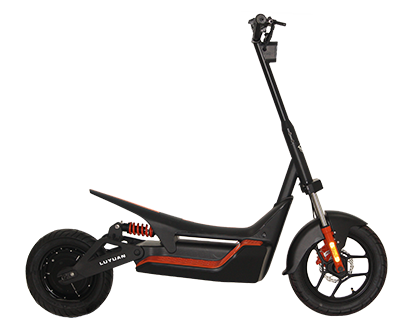
Available LUYUAN MKK versions combine aluminum-cylinder hydraulic front shock absorption with spring-hydraulic rear suspension, a comfort seat, and an oversized footboard. Exact brakes, suspension, and other equipment differ by trim, so buyers should compare the detailed configuration.
Suspension must manage compression and rebound while keeping the tires in contact. A setting or design that feels soft can still allow repeated bouncing or bottoming. Tests should use normal payload and speed, recording impact sharpness, rebound, steering movement, seat displacement, foot stability, and rider corrections.
Rough-route usability also depends on ergonomics. Seat support, foot space, handlebar reach, controls, visibility, and mounting affect fatigue and confidence on long journeys. Representative riders should provide specific feedback after the full duration, not only after a short smooth demonstration.
Maintenance preserves capability. Tire pressure, tread, brakes, suspension, fasteners, seals, connectors, cooling, battery condition, and software need model-specific checks. Unusual noise, leakage, warning, instability, or damage should trigger an authorized response before continued high-speed or rough-road operation.
The MKK story is strongest when every claim stays connected to the MKK Pro-Li highest configuration and a complete route system. Power, climbing, range, battery, charging, suspension, comfort, braking, rider skill, and maintenance must support the same difficult journey.
For practical evaluation, we would prioritize validating the all terrain electric scooter on the intended route with normal load, conservative speed, realistic battery state, and a safe return plan. The official LUYUAN MKK evidence we provide is useful, while repeat trials and exact configuration control determine whether it translates into dependable field performance.




Press: media@luyuan.cn
Telephone: +86-579-82272946
Business: market@luyuan.cn
Telephone: +86-579-82272528
Service: service@luyuangroup.com
Select your country or region
Global
Asia

中文