








Popular searches:
EB-S1
S90
MNK6
EB-S1E
Conquering a 30-Degree Climb: An All-Terrain Engineering Deep Dive


Jul 21,2026
A climbing number cannot describe a route by itself. Surface grip, ramp length, approach speed, rider and cargo mass, battery state, temperature, tire condition, and stopping space all matter. We evaluate an all terrain electric scooter as a system that must climb, remain controlled, and return safely.
The verified 30-degree figure belongs to the highest-configuration MKK Pro-Li test, not to every rugged model. For that configuration, we also report an 80 km/h maximum speed and a 90 km range, with actual results varying by vehicle configuration. We keep this limitation visible.
An electric scooter for rough terrain must first create usable tire contact. More rated power cannot help if the tire slips, the suspension loses contact, or weight transfer reduces control. Route suitability therefore starts with the surface and vehicle dynamics before it reaches the motor specification.
Another official example, the S75-Li highest configuration, reports 60 km/h, 80 km range, and 12-degree climbing. These figures should not be mixed with MKK results. Two products may both address difficult roads while using different configurations and verified performance envelopes.

Climbing Starts With Available Traction
The phrase electric scooter for rough terrain directs attention to tires, suspension, geometry, and braking as much as power. Tire compound, pressure, tread, contact area, and surface contamination influence grip. Loose stone, mud, wet paint, sand, and broken pavement can change the result within a few meters.
Suspension helps the wheel follow uneven ground, but overly soft or poorly controlled movement can disturb stability. Compression must absorb the obstacle, while rebound should return the wheel without repeated bouncing. Load and adjustment affect both behaviors, so a setting that suits one rider may not suit cargo.
For an all terrain electric scooter, the total vehicle and payload mass should remain within approved limits.Cargo that moves or sits too high changes balance on a climb. Riders should approach smoothly, remain within the manual's instructions, and avoid testing a steep route without adequate run-off and recovery options.
A representative evaluation records gradient, surface, length, payload, starting method, speed, battery level, temperature, and tire pressure. Repeating the route reveals consistency. A single successful ascent without controlled conditions cannot establish that the same vehicle will handle every hill or season.
Power Must Be Sustainable, Not Just High
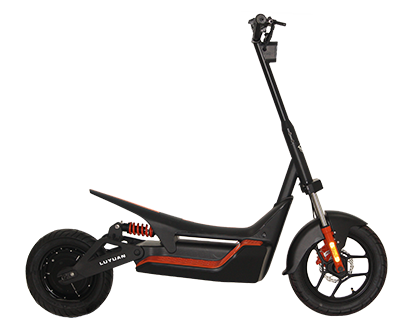
Our MKK provides an off-road electric scooter manufacturer example with 5,200 W rated power, a 72 V 45 Ah NCM battery, and a five-to-six-hour charging time for the highlighted configuration. We cite those values only within their displayed configuration and do not transfer them to the S75.
Power must reach the ground smoothly. Controller calibration, battery voltage under load, thermal management, motor efficiency, and traction determine whether a strong rating becomes controllable climbing force. Abrupt delivery can break grip, while excessive heat or protective limits can reduce sustained performance during a long ascent.
We equip applicable MKK configurations with Liquid-Cooled Motor 2.0, making it one of the model’s key technologies. Cooling is relevant because climbing can keep the motor under heavy load. Even so, no cooling system removes load limits, battery constraints, or the need to confirm the exact installed motor and controller for the ordered trim.
Commercial buyers should test repeated climbs rather than one peak attempt. The trial can monitor warnings, response, energy use, temperature behavior, and performance late in the session. It should include the normal payload and enough battery reserve for the return route, not only the first ascent from full charge.
Descending Safely Completes the Route
At LUYUAN, we treat descent as part of the same engineering problem. A vehicle that reaches the top must manage speed, heat, grip, and rider control on the way down. Brake condition, tire contact, suspension balance, payload position, and local technique all influence the return.
The current smart and driving-control materials list hill-descent control and describe low-speed management on steep descents. This analysis avoids assuming that every MKK or S75 configuration includes every assistance function. Buyers must verify model equipment, activation, cancellation, and operating limits before relying on it.
An off-road electric scooter manufacturer should provide brake specifications, maintenance guidance, load limits, tire recommendations, and test evidence for the proposed product. Riders need to understand that assistance does not replace manual observation or safe speed, especially on loose surfaces where braking can reduce available directional grip.
The complete route test includes stopping distance, brake feel, repeated-descent behavior, steering control, and safe parking on a slope. If weather or surface conditions change, the result should be reconsidered. A 30-degree laboratory or controlled test figure is not automatic permission for every public trail.
Climbing capability combines traction, controlled suspension, sustainable power, battery support, thermal management, braking, and rider technique. The verified 30-degree result is meaningful for the highest MKK Pro-Li configuration under its test conditions, but it should remain specific to that model and qualification.
The preferred approach is validating the intended route with normal payload, realistic battery state, surface, temperature, and a safe descent plan. A field test under normal operating conditions provides a much clearer basis for model selection than relying only on published climbing figures.




Press: media@luyuan.cn
Telephone: +86-579-82272946
Business: market@luyuan.cn
Telephone: +86-579-82272528
Service: service@luyuangroup.com
Select your country or region
Global
Asia

中文