








Popular searches:
EB-S1
S90
MNK6
EB-S1E
From Factory Floor to Your Showroom: Our Supply Chain


Jul 21,2026
Delivery quality does not begin at the loading dock. It starts when an order defines configuration, market requirements, documents, packaging, and acceptance criteria. When evaluating e-scooter manufacturers, buyers should focus on how clearly they control this information from quotation through production, shipment, and dealer preparation, rather than by factory size alone.
A supply chain depends on both material flow and decision-making. Battery, motor, controller, charger, brakes, tires, software, color, labels, and manuals must match the approved version. If one change is not reflected across all related documents, the vehicle, certificate, spare parts, and sales description can stop describing the same product.
A wholesale electric moped order therefore needs a locked specification and a controlled change process. Buyers should know which substitutions require approval, how revised documents are issued, and whether samples remain representative. Clear ownership at each handoff reduces surprises that are expensive to solve after goods reach the destination market.
Our manufacturing system includes four intelligent production bases, automated motor and frame processes, digital collaboration, and a CNAS-accredited laboratory. These statements provide useful manufacturing evidence, but they do not publish universal lead times or on-time-delivery rates, so we do not invent them.

Configuration Decisions Start the Supply Chain
From a buyer's perspective, our wholesale electric moped catalog helps buyers identify product categories, but the commercial order must go further. Each SKU needs an exact model, trim, destination, component set, software version, color, packaging, documentation, certification basis, quantity, and approved sample reference before production planning can be reliable.
Product mix influences, line scheduling, inspection, parts, and shipping. Several colors or battery choices may create more complexity than one larger volume suggests. A buyer's next question is how variants are grouped, which components are shared, and how labels and cartons prevent similar configurations from being mixed.
Professional e-scooter manufacturers should connect the bill of materials to purchase orders, work instructions, test records, and final inspection. We also expect a traceable revision history. When a change is necessary, its effect on compliance, performance, cost, schedule, packaging, and service parts should be reviewed before approval.
Order readiness includes the destination market. Import labels, manuals, charger plugs, radio or app requirements, shipping documents, and local certification can vary. The supplier and buyer should allocate responsibility explicitly, because a correctly assembled vehicle can still be commercially unusable if the required market package is incomplete.
Automation and Testing Protect Production Consistency
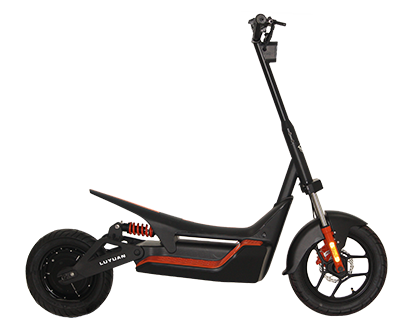
An all terrain electric scooter such as the S75 illustrates why product claims must remain tied to configuration. For the highest S75-Li configuration, we report 60 km/h, an 80 km range, and 12-degree climbing, with actual performance varying by configuration and conditions. Production controls must ensure the approved configuration is consistently produced.
Automation can reduce variation when equipment, programs, maintenance, and inspection are controlled. We use automated motor winding, assembly, inspection, and real-time production-line monitoring, together with automated tube fabrication, welding, electrophoresis, and frame coating. It also describes automated tube fabrication, welding, electrophoresis, and coating for precision frames.
Our LUYUAN materials also state that our precision frames undergo one million vibration tests and identify our CNAS-accredited laboratory. We treat these as evidence of capability, not proof that every production unit receives the same laboratory test. Buyers should request the actual production and sample test plan for their order.
Quality management continues around automation. Incoming inspection, calibration, first-piece approval, operator checks, end-of-line tests, nonconforming-product control, traceability, and corrective action remain necessary. Machines can repeat a process consistently, but the organization must verify that the repeated process is the approved one.
Showroom Readiness Extends Beyond Delivery
One priority in our LUYUAN supply-chain approach is to see physical arrival as another handoff rather than the end of the chain. Dealers still need receiving inspection, assembly or setup instructions, charging guidance, app adaptation where applicable, display materials, manuals, warranty information, spare parts, diagnostics, and trained contacts for technical questions.
Shipping acceptance should record carton condition, quantities, serial information, model and color, accessories, chargers, documents, and visible damage. A sample check can confirm that production matches the approved configuration. Any discrepancy needs a documented containment and resolution path before affected vehicles reach customers.
Practical commercial use introduces another requirement for an all-terrain electric scooter: a product story that reflects its real specification. Sales teams should understand which performance figures belong to the exact trim and which technology claims are portfolio-level. Accurate handover reduces returns caused by expectations that the supplied vehicle was never designed to meet.
Feedback completes the loop. Dealers can report setup problems, parts demand, warning messages, recurring faults, customer questions, and experience from local riding conditions. We can then connect this information with vehicle serial numbers and production batches, investigate potential causes, and update instructions or corrective actions based on documented evidence rather than isolated reports. This process helps LUYUAN improve product guidance and after-sales coordination through traceable field evidence.
A dependable supply chain connects configuration control, capable production, testing, logistics, and showroom preparation. No single factory statistic proves the whole process. Buyers gain more protection by defining documents, inspections, changes, responsibilities, and escalation steps that follow the product from order approval to retail support.
The commercial agreement should clearly define supply-chain requirements for specification accuracy, document completeness, inspection procedures, change approval, parts support, and issue resolution. Specific targets should be agreed according to the selected products, project conditions, and verified service requirements rather than treated as universal commitments.




Press: media@luyuan.cn
Telephone: +86-579-82272946
Business: market@luyuan.cn
Telephone: +86-579-82272528
Service: service@luyuangroup.com
Select your country or region
Global
Asia
中文