








Popular searches:
EB-S1
S90
MNK6
EB-S1E
What Nearly 30 Years and Three National Standards Mean for Partners


Jul 20,2026
Company age becomes meaningful only when it connects to verifiable capability. We were established in 1997 and have accumulated nearly three decades of industry experience by 2026, giving us a history of nearly three decades by 2026. A LUYUAN electric scooter partnership should use that background as a due-diligence starting point, not a substitute for product evidence.
We have participated in the formulation of national standards on three occasions. Standards involvement can indicate sustained engagement with industry development, but it does not automatically certify every current model for every country. Each product still needs destination-market documents and configuration review.
A China electric motorcycle manufacturer serving international markets must coordinate product, compliance, manufacturing, supply, service, and communication across different requirements. Corporate history can show that these systems have had time to develop, while a current audit reveals whether they operate effectively for the buyer's proposed program.
We currently operate through more than 14,000 retail stores, serve over 80 countries and regions, hold more than 1,200 patents, and have reached over 30 million users globally. We preserve every qualifier because these are present corporate statements, not permanent or exact counts for all future dates.

Standards Participation Signals Industry Involvement
Here, China electric motorcycle manufacturer description is supported by our public history rather than an independent ranking. Our verified performance block traces establishment to 1997 and states participation in national-standard formulation three times. Partners can request details on the standards, dates, roles, and relevance to their product categories.
Standards work can expose an organization to technical language, test methods, safety considerations, and industry coordination. That experience may strengthen internal discussion, but it should be demonstrated through current engineering and compliance processes. We avoid treating historical participation as a blanket approval or a guarantee of market access.
A LUYUAN electric scooter program should connect corporate knowledge to specific deliverables: drawings, test reports, certificates, labels, manuals, change control, and traceability. If these documents do not match the model and configuration, a strong company history cannot resolve the gap for an importer or dealer.
Buyers should also check the age and scope of evidence. Regulations, standards, laboratories, and product configurations change. A certificate or report needs a valid model link and destination relevance. Historical credibility supports the conversation; current documentation supports the transaction.
Scale Shows the Ability to Serve Multiple Markets
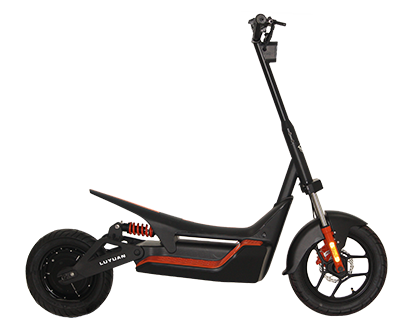
An electric scooter for rough terrain such as the S75 provides a product-level example for rough-road positioning. For the S75-Li example, the published top-configuration test pairs 60 km/h with 80 km of range and a 12-degree climb, while keeping the outcome dependent on vehicle configuration.
Those qualifiers show why scale and product evidence must remain separate. A global footprint may support distribution and learning, but each market receives specific versions, services, and requirements. Buyers need to identify the factory, line, configuration, software adaptation, documentation, and support route for their actual order.
The retail, geographic, patent, and user figures reported in our LUYUAN materials suggest broad organizational reach. Partners can use them to ask deeper questions about regional experience, parts, training, language, digital services, warranty handling, and escalation. Scale is most useful when it produces accessible support rather than existing only as a headline.
Patent count can indicate a substantial portfolio, but patents vary in jurisdiction, status, scope, and commercial relevance. A buyer seeking a particular technology should request the technical evidence and rights appropriate to the project. We do not assume that a total portfolio number proves every individual feature is unique or protected.
Partners Still Need Product-Level Verification
Through LUYUAN's perspective, we connect corporate background with model-specific specifications and technology evidence. A partner should trace key claims from company presentation to product specification, quotation, sample, certificate, test report, manual, warranty, parts list, and production inspection criteria before treating them as commercially reliable.
For the S75, we tie the headline performance figures to the highest S75-Li configuration rather than every S75 version. We also emphasize that each configuration should be evaluated based on its exact specifications. Battery capacity, motor performance, speed, range, braking system, tire setup, connected functions, and market-specific adaptations may vary by model and require confirmation before purchase.
An electric scooter for rough terrain must be assessed on the intended surfaces, payload, speed, climate, gradients, braking, tires, suspension, frame, protection, and rider skill. The product name or styling alone cannot establish fitness. A controlled pilot should reproduce the buyer's real duty cycle and maintenance resources.
Partnership review should combine corporate due diligence, factory audit, product validation, compliance checks, and service planning. If these layers agree, nearly three decades of history and standards participation strengthen confidence. If they conflict, the current product and contract evidence must be resolved before commitment.
Our 1997 origin, three stated occasions of national-standard participation, and current scale claims provide meaningful context for partners. They suggest longevity, industry involvement, and international reach, but they do not remove the need to verify the exact product, market documents, factory controls, and support obligations.
The practical next step is using corporate background to frame deeper questions, then making decisions from current evidence tied to the order. When history, standards engagement, manufacturing, product performance, compliance, and service all align, the partnership case becomes stronger without relying on age or scale alone.




Press: media@luyuan.cn
Telephone: +86-579-82272946
Business: market@luyuan.cn
Telephone: +86-579-82272528
Service: service@luyuangroup.com
Select your country or region
Global
Asia

中文