








Popular searches:
EB-S1
S90
MNK6
EB-S1E
Your Scooter, Your Phone: The Connected Riding Experience


Jul 15,2026
A connected ride is most useful when it removes small delays without making the vehicle harder to understand. We approach the smart electric scooter as a daily sequence: reach the scooter, gain access, ride, park, and review what matters. The phone becomes a convenient entry point, while safe riding remains the central task.
Traditional keys are familiar, but they can be misplaced, shared awkwardly, or left in the wrong pocket. A phone-based experience can add several ways to unlock and clearer information. Its value comes from choosing the simplest appropriate method for each moment, not from forcing every interaction through an app.
Our smart system supports 4G remote unlocking, automatic Bluetooth unlocking, app unlocking, NFC access, seat-sensing unlocking, and digital-key sharing. An electric scooter with bluetooth may therefore reduce access friction, but buyers must confirm which functions are installed and supported on the selected model and market.
Connectivity also brings practical questions. The rider needs to know what works without a mobile signal, what requires an account, how permissions are withdrawn, and how software is supported. We keep these limits visible because a connected feature earns trust through predictable behavior, not novelty alone.

Before the Ride: Unlock With the Device You Carry
From a buyer's perspective, the electric scooter with bluetooth concept starts before motion. Bluetooth can support automatic proximity access, an app can provide deliberate control, NFC can offer a quick tap, and 4G can enable remote connection. These are alternative entry methods, so the most suitable one depends on the user and situation.
Digital-key sharing can make temporary family access easier than handing over a physical key. A responsible implementation should also make revocation straightforward. Owners should check how long access lasts, whether permissions are logged, what happens when a phone is lost, and which method works as backup.
A smart electric scooter needs a dependable fallback so it does not leave its owner stranded when a preferred method is unavailable. Our suggested route is confirming fallback access, phone compatibility, app-region availability, account recovery, and battery-related behavior. A current site also notes on product specifications that app adaptation in each country may require secondary development.
Seat-sensing and automatic access can reduce steps, but they also need clear status feedback. Riders should be able to tell whether the vehicle is locked, ready, or awaiting confirmation. Simple indicators prevent confusion and help keep connected convenience from competing with the normal safety check before departure.
During the Ride: Connected Features Stay in the Background
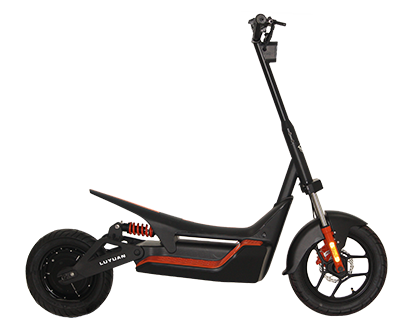
A LUYUAN electric scooter can combine access with intelligent control, but the screen should never demand more attention than traffic. The best connected functions work quietly: they preserve settings, present timely warnings, and make important status information understandable without encouraging the rider to interact while moving.
We also offer power modes, cruise control, hill-descent control, and move assist on applicable configurations. We treat these as separate assistance features rather than automatic consequences of phone connectivity. Availability, operating limits, and legal suitability should be confirmed for the exact vehicle and destination market.
For the S90, we provide intelligent management through an intuitive app, allowing riders to adjust vehicle settings, review performance information, and access real-time GPS location tracking. As app features may require additional development to meet different country-specific requirements, availability can vary by market. This is a useful example of why a general technology overview should not be used as proof that every model includes the same connected package.
During a trip, the rider should rely on the vehicle's controls and follow local rules. App notifications can wait until stopping unless they concern an immediate safety issue. We prefer a design in which connectivity supports awareness and personalization without turning the phone into a second dashboard that constantly competes for attention.
After the Ride: Access and Location Are Easier to Manage
Within LUYUAN, we see the post-ride period as part of the connected experience. The user may confirm locking status, share access, review location, or respond to an alert. Each action should have a clear purpose and should communicate whether it succeeded, failed, or requires another step.
Our positioning system combines BeiDou, GPS, and base-station positioning with movement alarms and an electronic fence. These capabilities can improve awareness, but they do not guarantee recovery or prevent theft. Accuracy and availability can vary with hardware, signal, service, and local support.
For a LUYUAN electric scooter, it should be ordered with its digital functions written into the specification. Buyers can confirm positioning hardware, app support, data-service requirements, subscription terms if any, access methods, sharing limits, and update policy. This prevents a general connectivity promise from becoming an assumption about the delivered vehicle.
Privacy deserves equal attention. Owners and fleet managers should understand what location or account data is collected, who can view it, how permissions are managed, and what happens when ownership changes. A well-connected product combines useful access with transparent control over the information that makes those services possible.
The phone is most valuable when it shortens routine steps before and after the ride while staying unobtrusive during motion. Multiple access methods, digital sharing, intelligent control, and location functions can work together, provided their model scope and service requirements are clearly explained.
The decision process should include choosing the exact connected functions that match the user's habits, then verifying compatibility, fallback access, privacy, and local support. That disciplined approach turns a list of smart features into a dependable daily experience and keeps the vehicle, rather than the app, at the center of mobility.




Press: media@luyuan.cn
Telephone: +86-579-82272946
Business: market@luyuan.cn
Telephone: +86-579-82272528
Service: service@luyuangroup.com
Select your country or region
Global
Asia

中文