








Popular searches:
EB-S1
S90
MNK6
EB-S1E
Why Motors Lose Power on Long Rides—and How We Addressed It


Jul 09,2026
A strong launch does not guarantee steady performance after an hour on the road. We focus on the liquid cooled motor because sustained speed, repeated acceleration, gradients, load, and ambient heat can raise internal temperature. When heat is not managed, a motor may feel less responsive even though its rated specification has not changed.
The basic challenge is continuous heat removal. An electric motor liquid cooling system moves coolant through the working assembly so heat can leave critical areas more consistently. We judge performance across a route and duty cycle, rather than treating a brief peak-power figure as proof of durable output.
Long rides also expose a second risk: moisture. Rain, standing water, washing, and humid storage can encourage corrosion if water reaches internal surfaces. That damage may develop gradually, so a useful engineering response must address both thermal stability during use and protection when the vehicle meets difficult weather.

Heat Can Turn Peak Power Into Power Fade
Every motor converts some input energy into heat. During short, light trips, ambient airflow may dissipate enough heat. Under sustained load, however, heat can accumulate faster than it escapes. An electric motor liquid cooling system provides a controlled thermal-management mechanism for transferring heat away from the motor rather than relying solely on external airflow.
A liquid cooled motor is designed around that continuous thermal path. We state that circulating aerospace-grade coolant can reduce motor temperature by up to 38°C. The words ‘up to’ matter: the achieved reduction depends on the motor version, test conditions, road load, speed, weather, and vehicle configuration.
Lower operating temperature helps protect magnetic properties and makes efficiency easier to maintain under pressure. It does not create unlimited power, and it cannot cancel the effects of an overloaded vehicle or a depleted battery. What it can do is reduce one important source of avoidable performance decline.
We also separate thermal fade from a low state of charge. Repeating the same route with logged battery level, payload, and temperature helps identify the cause. Without that control, a normal voltage-related reduction can be mistaken for a motor cooling problem.
Moisture Creates a Different Long-Term Risk
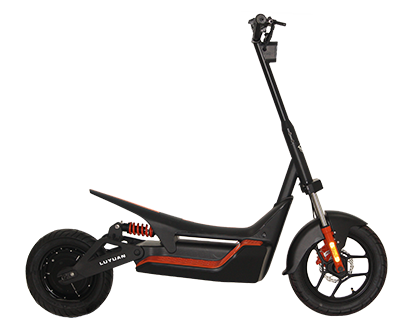
Buyers searching for a high performance electric scooter should look beyond acceleration and top speed. Sealing, connector design, drainage, corrosion resistance, and maintenance access affect how confidently a vehicle can work through changing conditions. A powerful specification is valuable only when the supporting system remains dependable over repeated use.
Long-ride riding development at LUYUAN starts by identifying high-temperature demagnetization and moisture-induced rust as two chronic motor problems. That framing is useful because the failure mechanisms are different: heat threatens magnetic characteristics while water threatens internal materials. Treating only one issue leaves the other able to shorten useful service life.
We list IPX8 waterproofing for applicable models in our liquid-cooled motor series. That rating is meaningful evidence of water protection under defined tests, but it is not permission to ignore care instructions. Buyers should still confirm the exact model rating and avoid assuming every component shares the same classification.
Seasonal inspection adds another layer of protection. Technicians can check cables, seals, connectors, mounting points, and signs of contamination while reviewing any stored warnings. A scheduled check is easier to manage than waiting for a performance change to interrupt a busy route.
Liquid Cooling Targets Stability and Protection
Our approach at LUYUAN is to connect cooling, sealing, and corrosion control rather than presenting them as isolated features. That system view is the main benefit: thermal management helps during sustained riding, while water protection supports durability across rain, washing, and storage. The result is a more credible foundation for consistent everyday performance.
A high performance electric scooter also depends on its battery, controller, tires, brakes, load limits, and software calibration. This keeps us from attributing the whole riding experience to one component. Motor cooling is strongest when the rest of the vehicle is specified for the same duty cycle.
A practical evaluation should use a representative route with hills, stops, full operating load, and enough duration to reveal heat buildup. Riders should compare response early and late in the run, check warning behavior, and review service guidance. That tells more than a showroom demonstration or an isolated number.
For dealers, the explanation should remain simple: the system is designed to manage heat and resist water-related damage, while the complete vehicle determines the ride. That distinction lets customers value the technology without receiving a promise that operating conditions can never affect output.
Our approach to long-ride power is straightforward: identify the mechanisms behind decline and engineer around them. Active coolant circulation addresses accumulated heat, while the applicable protection measures reduce exposure to moisture-related damage. Together, those choices support steadier operation without promising that every route will produce identical results.
The most responsible buying decision still begins with the exact configuration. Motor version, battery capacity, controller tuning, rider weight, terrain, temperature, and maintenance can all change real performance. We encourage buyers to verify specifications for their market and test the vehicle under conditions that resemble their daily work.
When those checks are completed, the value of the design becomes clearer. We are not relying on peak output alone; We do not focus on peak output alone; our design is intended to support more consistent motor performance over repeated use. For commuters, delivery riders, and fleets, that distinction can help translate strong initial performance into a more dependable long-term experience.




Press: media@luyuan.cn
Telephone: +86-579-82272946
Business: market@luyuan.cn
Telephone: +86-579-82272528
Service: service@luyuangroup.com
Select your country or region
Global
Asia

中文