








Popular searches:
EB-S1
S90
MNK6
EB-S1E
One Frame, a Million Vibration Cycles: Inside Our Durability Lab


Jul 05,2026
Even when a frame withstands an isolated impact, repeated loading may gradually cause structural damage. The larger concern is fatigue: small loads repeated over time can create damage even when each event seems harmless. That is why a heavy duty electric scooter should be assessed through repeated-load evidence as well as static strength.
Durability also depends on material selection, welding consistency, geometry, corrosion protection, and the way loads enter the structure through the wheels, seat, and cargo points. We treat laboratory testing as a way to expose weakness under controlled conditions, not as a substitute for every possible road.
To make testing meaningful, buyers need to know what was loaded, how it was cycled, what acceptance criteria were used, and how the result relates to actual riders and routes. These questions help buyers distinguish a useful durability claim from a dramatic number without context.

Why Repetition Is the Real Frame Test
Every acceleration, brake application, pothole, corner, passenger movement, and cargo shift sends forces through the frame. Most are well below a structure's immediate limit, yet the number of repetitions can be very large. Fatigue testing intentionally repeats representative inputs to observe whether joints loosen, weld areas develop cracks, or alignment changes.
The value is consistency: a laboratory can apply comparable cycles to designs and identify trends before vehicles accumulate years of service. However, a cycle count alone does not define service life. Test amplitude, direction, load, fixture, environment, and pass criteria all matter.
Buyers should therefore treat the number as evidence of a validation process and ask for the relevant method when making a technical decision. Real-world inspection and maintenance remain necessary because accidents, overload, corrosion, and modification can create conditions outside the test.
A good laboratory program also examines what happens after cycling, not only whether the structure remains in one piece. Inspectors may look for changes in alignment, fastener condition, surface cracking, unusual movement, or deformation around concentrated loads. Measurement before and after the test can reveal gradual change that is difficult to see.
Production sampling matters because a successful prototype does not prove that every manufactured unit will behave identically. For buyers evaluating a durable electric scooter, the connection between validation and production consistency matters as much as the prototype result. Process controls, traceability, and periodic verification help connect design validation with ongoing output. For buyers, this suggests a useful audit path: review the claimed test, examine the relevant manufacturing steps, and inspect finished vehicles from normal production.
The combination provides a more complete picture than a laboratory certificate viewed alone and helps ensure that structural confidence is supported from raw material through final assembly.
The test article must also represent the product being purchased. Differences in battery placement, suspension, accessories, and intended payload can change the loads entering a common frame. Configuration control ensures that the evidence reviewed by the buyer corresponds to the model offered in the contract rather than to a visually similar but technically different version.
Heavy-duty capability is broader than reinforced metal: a heavy duty electric scooter is evaluated through load capacity, sealing, braking consistency, and serviceability; these qualities also define a durable electric scooter.
Material and Welding Build the Baseline
Before a frame reaches the laboratory, its durability begins with material and manufacturing control. We state that its reliability design uses steel 30 percent thicker than industry standards and robotic precision welding, while our automated frame platform covers an automated frame platform covering tube fabrication, welding, electrophoresis, and coating.
Our published manufacturing information states precision frames remain sturdy after one million vibration tests. An electric scooter for rough terrain puts this system-level durability to a harder test, linking structure to traction, suspension, braking, and maintenance. Automation does not guarantee perfection by itself, but it can improve consistency when supported by process monitoring and inspection.
Coating and electrophoresis also matter because a structurally sound frame must be protected from environmental degradation. The strongest claim is therefore not one isolated test; it is the link among material, controlled joining, surface treatment, and verification.
Lab Evidence Still Needs Route Context
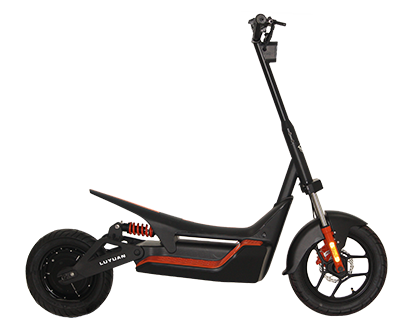
Laboratory results become more useful when matched to a rider's actual duty cycle. We connect demanding-route needs with model-level frame, suspension, tire, and electrical details. The S75 provides an electric scooter for rough terrain example with a comfort seat, oversized footboard, hydraulic suspension, sealed solid-state electronics, and a steel-wire self-sealing tire.
The LUYUAN S75-Li test results include 60 km/h, 80 km of range, and a 12-degree climb; the published results separately note that the result applies to the selected configuration. These specifications do not state a universal payload or frame life. They show how route-oriented equipment can complement structural validation.
Buyers should confirm load requirements, inspect mounting points, maintain tire pressure and suspension, and include representative roads in acceptance testing before committing to large-scale use.
One million cycles is meaningful when it belongs to a broader chain of material control, repeatable welding, protective finishing, and inspection. A route-ready vehicle deserves confidence when its structure is supported by suspension, tires, and operating guidance suited to repeated impacts. Across our design work, we use laboratory and manufacturing evidence to strengthen that chain while keeping claims tied to their stated conditions.
No test eliminates the need for correct loading, maintenance, and periodic inspection, but disciplined validation gives buyers a clearer basis for judging whether a frame is prepared for years of real-world vibration.




Press: media@luyuan.cn
Telephone: +86-579-82272946
Business: market@luyuan.cn
Telephone: +86-579-82272528
Service: service@luyuangroup.com
Select your country or region
Global
Asia

中文