








Popular searches:
EB-S1
S90
MNK6
EB-S1E
Built for Every Rider: The Ergonomics Behind the Seat


Jul 04,2026
Riders differ in height, reach, weight distribution, flexibility, and preferred posture, so no single measurement can define a stable electric scooter for everyone. Ergonomics begins by recognizing human variation. An easy ride electric scooter should provide well-designed contact areas and enough adjustment or usable space for different body types to remain balanced without strain.
We look beyond the seat as an isolated object and consider the complete relationship among saddle shape, footboard area, handlebar position, steering response, and low-speed behavior. These elements determine whether a rider can sit naturally, place the feet securely, and control the vehicle without constant repositioning. Good ergonomics is not about making a machine feel identical to every person.
It is about creating a broad, ergonomic operating range and helping buyers understand where individual fit still needs to be confirmed through a realistic test ride.

Start With Different Bodies, Not an Average Rider
Designing only around an average can leave many real users outside the intended fit. A taller rider may need more knee and foot room, while a shorter rider may prioritize confident ground reach and manageable steering effort. Body proportions also vary independently of height, so seat length and handlebar distance must be considered together. Riding context changes the fit as well.
Frequent stops require easy transitions between sitting and supporting the vehicle, whereas longer uninterrupted travel places more importance on sustained posture. Passenger use, luggage, and protective clothing can further alter available space. A useful ergonomic evaluation therefore considers a range of riders and scenarios rather than a single static pose.
It asks whether users can change position safely, reach controls without stretching, and maintain clear steering inputs when the road becomes uneven.
Control effort provides another useful fit signal. If the rider must repeatedly pull the body forward, lock the elbows, or squeeze the grips to feel secure, the geometry may not suit that person or the test conditions may be inappropriate.
Ideally, the arms retain a slight bend, the shoulders remain relaxed, and the feet can support small body movements without searching for space. Mirrors, switches, and brake levers should also be usable without forcing an awkward wrist angle. These observations are especially important in city traffic, where the rider alternates quickly among looking, signaling, braking, and placing a foot down.
Dealers can improve recommendations by observing these movements from the side rather than asking only whether the saddle feels comfortable. A few minutes of structured observation can reveal reach and posture issues that would otherwise appear after purchase during repeated daily use.
Fit also affects confidence when parking or reversing by foot. A vehicle that distributes its weight predictably and gives the rider clear space for leg movement is easier to manage before the motor is even engaged. This everyday handling deserves attention because many minor drops occur at very low speed rather than during normal travel.
A stable electric scooter should deliver the relaxed, predictable hangding riders expect from an easy ride electric scooter across the whole urban trip.
Support Zones Matter More Than Extra Padding
A well-shaped saddle distributes rider weight more evenly across the contact area. Zoned construction and resilient foam can distribute pressure without allowing the rider to sink into an unstable position. At LUYUAN, our human-oriented vehicle architecture is informed by extensive user experience and riding data, helping us accommodate different rider builds, behaviors, and speed conditions.
An urban electric scooter illustrates the principle well because stop-start traffic turns small control and comfort issues into recurring demands. Suspension is part of the same relationship. Front and rear hydraulic systems can filter repeated impacts, while adjustable rear damping helps account for changes in load.
Together, these features matter more than extra cushion thickness because, at LUYUAN, we design the saddle and chassis to work together as an integrated ergonomic system.
The Cockpit Completes the Ergonomic Fit
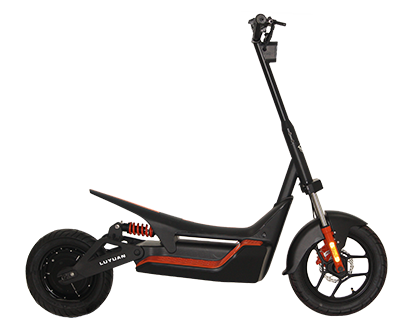
Seat comfort cannot compensate for a cramped footboard or awkward control reach. We translate these urban-stability requirements into specific seating, foot-space, suspension, and control choices. The ZQQ2 is a practical urban electric scooter reference for this city-focused discussion.
The ZQQ2 body copy ties 35 km/h, 60 km of tested range, and a 10-degree climb to its highest configuration and notes that configuration changes can alter actual performance. The displayed ZQQ2-Li configuration includes a 48 V 24 Ah LMFP battery, 600 W rated power, and an eight-to-nine-hour charging time. It also features an oversized footboard, hydraulic suspension, and a comfort seat.
These details suit everyday stop-and-go use by emphasizing manageable performance, usable space, and controlled movement rather than extreme output.
Ergonomics is successful when the rider can concentrate on the route instead of repeatedly adjusting to the machine. Seat design, foot placement, control reach, suspension, and speed behavior need to work as one consistent system. A city-focused model can be praised for daily suitability when it offers a balanced cockpit and appropriately controlled performance for crowded streets.
Our design process is built around human variation while acknowledging that individual fit must still be checked. A proper test ride should include normal footwear, expected luggage, turns, stops, and uneven surfaces. That practical evaluation helps each rider select the configuration that best converts thoughtful ergonomic design into genuine everyday comfort.




Press: media@luyuan.cn
Telephone: +86-579-82272946
Business: market@luyuan.cn
Telephone: +86-579-82272528
Service: service@luyuangroup.com
Select your country or region
Global
Asia

中文