








Popular searches:
EB-S1
S90
MNK6
EB-S1E
Long Rides, Zero Aches: What Makes a Scooter Truly Comfortable


Jul 02,2026
A vehicle can feel pleasant for ten minutes and become tiring after an hour. Ride quality over time matters because minor pressure, vibration, and posture problems repeat thousands of times. A long distance electric scooter should therefore be evaluated by how well it manages accumulated stress, not only by whether the seat initially feels soft.
An easy ride electric scooter also needs to reduce the number of small corrections a rider makes with the hands, shoulders, back, and legs. We can understand this experience through three connected questions: how body weight is distributed, whether the riding position remains neutral, and how effectively the chassis controls repeated road movement.
No design suits every rider perfectly, because body size, fitness, route, weather, and riding habits vary. However, thoughtful ergonomics can make longer journeys substantially more manageable and help riders arrive with more energy.

Pressure Distribution Comes Before Softness
Long rides expose the difference between cushioning and support. Very soft foam may feel inviting at first, yet it can compress until weight is concentrated on a small area. Zoned support and resilient foam aim to spread pressure more evenly across the saddle.
Shape is equally important because it should allow the rider to shift position slightly without sliding or fighting the vehicle. The contact between hands and grips also deserves attention. If the rider must hold the bars tightly to compensate for an unstable posture, fatigue can appear in the wrists and shoulders even when the saddle initially feels soft.
A practical evaluation should include normal clothing, expected luggage, repeated stops, and enough time for pressure points to become noticeable. This reveals more than a short test and helps match saddle geometry to the actual rider.
Range planning has an ergonomic dimension as well. A rider who becomes uncomfortable may stop more often, change posture abruptly, or grip the controls more tightly, all of which can make the journey feel longer and less predictable. Route design can reduce this burden.
Alternating faster and slower sections, identifying safe rest points, and avoiding unnecessary rough surfaces may improve the experience without changing the vehicle. Clothing also matters: seams, thick items in pockets, or restrictive protective equipment can create pressure that is mistakenly blamed on the saddle. A careful test separates these influences.
We suggest checking the rider’s condition at several intervals rather than waiting until the end, noting the location and type of discomfort and whether a small posture change resolves it. This method gives buyers and designers more useful feedback than a simple yes-or-no impression and supports better configuration choices for sustained riding.
Dealers can support this process by recording rider height, general build, route length, and the point at which discomfort appears. Over time, those observations create a practical fit guide for different use cases. They also prevent range discussions from ignoring the person who must remain at ease enough to use that range.
Long-distance suitability comes from the same balanced traits expected of an easy ride electric scooter, so a long distance electric scooter cannot be reduced to a single comfort component.
A Stable Posture Saves Energy Over Distance
Posture determines how much muscular effort is required simply to remain in place. A wide footboard gives the feet more options, while suitable seat-to-handlebar relationships can reduce unnecessary forward reach. Our human-oriented architecture at LUYUAN draws on large-scale riding experience and accumulated riding data to accommodate different builds and behaviors.
An all terrain electric scooter provides a useful example once range, comfort, and surface control are considered together. The vehicle should support a relaxed core without making steering slow or disconnected. It should also give the rider room to adjust position safely as conditions change.
These qualities may seem modest, yet they help reduce muscle fatigue during long rides while allowing riders to stay focused on traffic, changing road surfaces, and route decisions.
Suspension Protects Comfort Mile After Mile
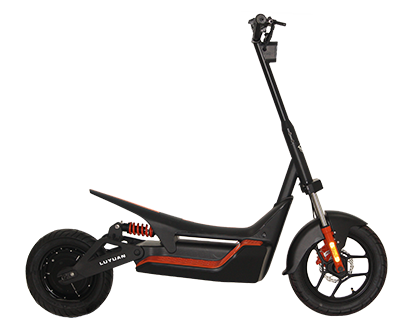
Repeated vibration is another source of cumulative fatigue. Hydraulic suspension can filter potholes, joints, and speed bumps before their full force reaches the body, while controlled rebound helps keep the chassis from continuing to oscillate. With LUYUAN, we can move the discussion from general long-ride principles to a defined product configuration and route test. The S75 offers an instructive all terrain electric scooter case.
For S75-Li, the top configuration is presented with 60 km/h, an 80 km test range, and a 12-degree climb; the published configuration notes that another vehicle configuration may return a different result. The listed configuration includes a 72 V 30 Ah LFP battery, 1,500 W rated power, and a five-to-six-hour charging time.
Its product information also highlights a comfort seat, oversized footboard, hydraulic suspension, sealed solid-state electronics, and a steel-wire self-sealing tire. These features connect endurance with practical control and protection rather than treating range as an isolated number.
Long-ride comfort is built from the way pressure, posture, and vibration are managed together. A good saddle distributes weight, a balanced cockpit limits static strain, and suspension reduces the repeated impacts that accumulate over distance. A route-ready vehicle can be especially valuable when it combines those qualities with equipment suited to changing surfaces.
At LUYUAN, we treat rider well-being as an engineering system that supports usable range, not as a decorative extra. Riders should still test the selected configuration, adjust their posture, maintain proper tire pressure, and take sensible breaks. Those steps acknowledge real human limits while allowing well-designed hardware to make every kilometer more controlled and enjoyable.




Press: media@luyuan.cn
Telephone: +86-579-82272946
Business: market@luyuan.cn
Telephone: +86-579-82272528
Service: service@luyuangroup.com
Select your country or region
Global
Asia

中文