








Popular searches:
EB-S1
S90
MNK6
EB-S1E
The Engineering That Makes Bad Roads Disappear


Jul 01,2026
Broken pavement does not challenge a vehicle with one simple force. A deep pothole sends a sharp impact upward; repeated patches unsettle the chassis, while loose or wet surfaces may reduce grip. For that reason, the best electric scooter for bumpy roads cannot be defined by suspension travel in isolation.
The system must manage the path of energy from the tire through the suspension and frame while maintaining predictable steering. A stable electric scooter also needs to recover quickly after each disturbance instead of continuing to bounce or transferring every shock to the rider. We approach bad-road performance as a chain of engineering decisions.
Effective rough-road control keeps the wheel in useful contact with the ground, regulates compression and rebound, limits unwanted chassis flex, and moderates power when traction changes. This is how roughness becomes manageable rather than merely hidden.

First, Control the Impact at the Wheel
The first task is to slow and distribute the movement created when a wheel meets an obstacle. A tire can absorb the smallest irregularities, but larger impacts require the suspension to compress in a controlled way. If compression is too stiff, the impact passes directly into the chassis.
If it is too soft, the vehicle may accelerate too quickly and lose traction. Rebound matters just as much because the wheel must return without throwing the chassis upward. Front and rear systems should therefore be considered together. Load, rider weight, tire condition, and speed all change the result, which is why adjustment can be valuable.
Good damping does not erase information from the road; it removes unnecessary harshness while keeping enough feedback for the rider to understand available grip and choose a suitable line.
Tire pressure is another part of the system and should not be used as a substitute for correct suspension tuning. Excessively low pressure may soften small impacts, but it can reduce steering precision, increase heat, and expose the tire or rim to damage. Excessively high pressure can transmit more surface texture and reduce the size of the contact patch under some conditions.
For tire pressure, we follow the guidance provided by the vehicle and tire manufacturers, adjusting it only within the recommended limits for load and intended use. Riders should also observe how the vehicle behaves during braking immediately after a bump. If the chassis is still moving excessively, available grip and steering confidence may be reduced at exactly the wrong moment.
A disciplined road test should therefore include isolated obstacles, repeated irregularities, turns, and controlled braking on a safe route. This broader evaluation reveals how well the components cooperate instead of rewarding one dramatic demonstration.
Finally, the rider should distinguish comfort from control. A setup can feel plush on one obstacle yet allow too much movement over a series of waves. The stronger result is measured by how quickly the vehicle returns to a settled state and how clearly it follows the chosen direction.
The best electric scooter for bumpy roads is therefore judged by whether it remains a stable electric scooter across repeated impacts, steering corrections, and braking—not by suspension travel in isolation. For us, comfort on damaged roads means fewer sharp impacts, quicker chassis recovery, and less corrective effort from the rider over time.
Then, Keep the Chassis Settled
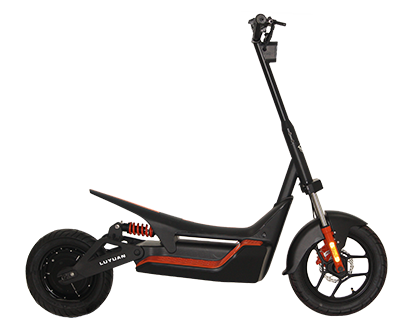
A controlled wheel is only useful if the rest of the vehicle remains composed. Frame geometry, structural stiffness, seat position, and footboard space influence how forces travel through the chassis and how easily the rider can stay balanced. Our driving-control approach uses front and rear hydraulic suspension, including five-level rear adjustment, to absorb common urban road impacts.
Against that background, electric scooter hydraulic suspension matters because it must manage repeated impacts without disconnecting the rider from the road. In our work at LUYUAN, selectable riding modes also help adapt power delivery to changing route demands. We also use selectable riding modes so power delivery can be adapted to route demands. That helps prevent a sudden response from upsetting the chassis immediately after a bump.
Our objective is a vehicle that settles promptly, maintains a clear direction, and asks for fewer corrective movements from the rider, especially when irregular surfaces continue for several kilometers.
Finally, Manage Power When Grip Changes
Road damage often appears with dust, standing water, or painted surfaces, so suspension must work with traction management. We offer a useful case for examining how suspension, structure, and rider control work as one system. Traction control can respond to detected slip by adjusting power, while hill-start assistance helps prevent rollback and hill-descent control supports lower-speed management on slopes.
The MKK illustrates how an electric scooter hydraulic suspension can combine these control principles with strong chassis capability. For the highest-configuration MKK Pro-Li test, we report 80 km/h, 90 km of range, and a 30-degree climbing capability.
That configuration lists a 72 V 45 Ah NCM battery, 5,200 W rated power, and a five-to-six-hour charging time. Actual performance varies by configuration, load, surface, and operating conditions, so the figures should guide evaluation rather than replace route testing.
We engineer our vehicles to make damaged road surfaces feel far less intrusive while preserving control and ride quality. Tire contact, hydraulic damping, chassis structure, rider position, and power management each solve a different part of the problem.
A complete suspension system proves its value when the wheels follow the surface and the vehicle remains predictable, not merely when it feels soft at low speed. Across our design work, we bring these elements together to support riders facing potholes, slopes, and changing grip.
The right configuration still depends on the route and expected load, yet a system-based design provides a stronger foundation for confident travel than any single feature can offer.




Press: media@luyuan.cn
Telephone: +86-579-82272946
Business: market@luyuan.cn
Telephone: +86-579-82272528
Service: service@luyuangroup.com
Select your country or region
Global
Asia

中文