

S95
M05
S90 (EEC)
MQN8
MKK
S75
S70 Pro (EEC,EMARK)
S70 (EEC)
ZQQ2 (EEC)
DM 01
G01
EB-S1E (EEC)
EB-S1 (CE)
EB-S2 (CE)
EB-2M (CE)
EB-2C (CE)
FB-03 (EN15194)
EB-1M (CE)
KS 01 (EN17128)







Popular searches:
EB-S1
S90
MNK6
EB-S1E
What Dealers Should Know About Long-Range Demand Before Recommending LUYUAN S90


Sep 10,2026
A customer asking for a long-range scooter is rarely asking about distance alone. From a dealer’s perspective, the more useful question is why that customer needs the extra range in the first place. A commuter may want fewer charging interruptions, while a high-frequency rider may be concerned about whether the scooter can fit into a demanding daily routine.

That difference changes how the product should be recommended. We believe dealers can make better S90 recommendations when they first understand the riding pattern behind the request and then connect that pattern with the product itself.
Long-Range Demand Starts With the Rider’s Daily Pattern
“Long range” can describe very different customer expectations. One rider may travel a moderate distance every day but dislike charging frequently. Another may spend most of the day on the road and see battery capacity as part of the vehicle’s basic usability. A third customer may simply want more flexibility because their route changes from day to day.
Dealers should therefore ask what a normal day actually looks like before moving directly to a model recommendation. How often does the customer ride? Are trips concentrated around commuting hours, or does riding continue throughout the day? Does the customer return home between trips, or does the scooter remain in use for several consecutive journeys?
Those answers help a dealer understand whether long range is a primary product requirement or simply a preference. They also make the conversation with an electric scooter distributor more specific when additional product information or sourcing support is needed.
A Dealer Should Sell the Routine, Not Just the Range
Customers often arrive at a showroom with a number in mind because range is easy to compare. Yet the number itself does not explain whether a scooter will feel suitable after weeks or months of regular use.
A stronger recommendation starts with the customer's routine. Imagine two riders with similar daily mileage. One has a predictable commute and convenient charging at home. The other makes several stops across a city and cannot easily return to a charging point. Their expectations from the same stated range can be completely different.
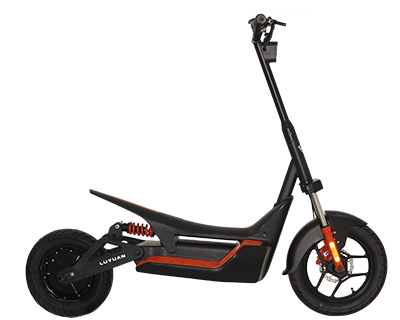
This is where the S90 becomes easier to discuss. Rather than presenting our LUYUAN electric scooter S90 simply as a long-range option, a dealer can explain why its positioning may make sense for customers whose riding schedule places greater value on endurance and fewer charging interruptions.
The conversation becomes less about selling a specification and more about matching a product to a recognizable customer type.
What Long-Range Customers Notice After the First Few Weeks
A test ride tells a customer how a scooter feels for a short period. It does not show how the vehicle fits into a repeated weekly routine. Dealers should pay attention to the issues that become visible only after the novelty of a new vehicle disappears.
Charging frequency is one example. A rider who needs to charge after every demanding day may perceive the ownership experience very differently from someone who has more flexibility between charges. Route changes matter as well. Customers who occasionally extend their journeys may value additional range because it reduces the need to plan every trip around the battery.
Usage intensity is another factor. A customer who rides occasionally does not necessarily need the same product positioning as someone who spends several hours on the scooter every day.
These distinctions give dealers a better way to explain why a long-range model belongs in the recommendation. The product is not being positioned around one impressive number; it is being connected to the way the customer expects to use it.
S90 Gives Dealers a Concrete Model to Discuss
A dealer still needs a specific product to put behind the recommendation. That is where LUYUAN electric scooter S90 can become a useful reference.
The current product range places S90 within its performance-oriented scooter lineup, while the S90 product information gives dealers a concrete model around which to build the discussion.
Instead of presenting the model to every customer who says “I want long range,” dealers can use a few simple distinctions. Is the customer riding frequently enough for endurance to influence the buying decision? Does the customer value fewer charging interruptions? Is the customer looking for a higher-positioned scooter rather than a basic everyday model?
The answers help determine whether the S90 should be introduced early in the conversation or whether another model in the range would make more sense.
That approach also helps dealers avoid over-recommending a premium or performance-oriented product to customers whose actual requirements are much simpler.
The Dealer’s Questions Shape the Product Recommendation
A useful sales conversation does not need to sound technical. Four or five practical questions can reveal much more than a specification sheet.
Ask how far the customer normally rides in a day, but also ask how those kilometers are distributed. A customer making several short trips may have different expectations from someone completing one long journey.
Ask where charging usually happens. Home charging, workplace charging, and limited access to charging can lead to very different perceptions of the same battery capacity.
Ask whether the customer expects their riding pattern to change. A scooter that works for today's commute may become less suitable if the customer expects longer routes, additional stops, or more frequent riding.
Finally, ask what the customer means when they say “long range.” Some customers mean maximum distance. Others really mean convenience, fewer charging sessions, or confidence that an unexpected extra trip will not become a problem.
Those answers give the dealer a much clearer basis for recommending a product and also create better questions for an long range electric scooter supplier when the dealership needs further product or sourcing information.
Long-Range Positioning Also Matters to the Dealer
The value of a long-range model does not end with the individual sale. Dealers need to think about how the product fits their local assortment.
If customers regularly ask about endurance, the dealership needs a model that can anchor that part of the range without forcing every customer toward the same product. The S90 can then occupy a defined position within the showroom conversation: a model to consider when riding frequency, route demands, and expectations around endurance justify looking beyond simpler options.
That positioning also gives sales staff a more useful explanation than “this one has a longer range.” They can describe who the model is intended for and why it deserves consideration.
For a dealer, that clarity matters because product knowledge becomes easier to transfer across the sales team. Staff members can work from the same customer questions rather than relying on whichever specification they happen to remember.
Turn Long-Range Interest Into a Better Dealer Conversation
Long-range demand is ultimately a customer-understanding issue before it becomes a product issue. Dealers who ask about daily routines, charging access, riding frequency, and expected usage can distinguish genuine endurance requirements from a general desire for a better scooter.
That distinction makes our S90 easier to recommend responsibly. It also gives the dealer a clearer basis for discussing product details, market positioning, and future stocking decisions with a long range electric scooter supplier.
For dealerships that want to take that product conversation further, the next step is not simply to request another catalog. A more useful partnership discussion starts with the customer demand the dealer is already seeing, the models that appear relevant, and the role those models need to play in the local product range.




Press: media@luyuan.cn
Telephone: +86-579-82272946
Business: market@luyuan.cn
Telephone: +86-579-82272528
Service: service@luyuangroup.com
Select your country or region
Global
Asia

中文