

S95
M05
S90 (EEC)
MQN8
MKK
S75
S70 Pro (EEC,EMARK)
S70 (EEC)
ZQQ2 (EEC)
DM 01
G01
EB-S1E (EEC)
EB-S1 (CE)
EB-S2 (CE)
EB-2M (CE)
EB-2C (CE)
FB-03 (EN15194)
EB-1M (CE)
KS 01 (EN17128)







Popular searches:
EB-S1
S90
MNK6
EB-S1E
How LUYUAN S95 Links Product Performance with Liquid-Cooled Motor Thinking


Sep 08,2026
A motor can deliver substantial power, but the way that power is managed matters just as much as the headline figure. Heat is one of the engineering variables that manufacturers have to address when developing electric two-wheelers, particularly when a vehicle is designed around stronger performance. We therefore view liquid cooling not as a marketing label, but as an engineering approach that helps explain how the motor and the overall power system are designed to operate.

Performance Starts With Managing Heat
Motor performance does not exist in isolation from temperature. Electrical and mechanical components generate heat during operation, and the thermal conditions inside a motor can influence how engineers approach its design and operating envelope.
That is where a liquid-cooled motor becomes relevant. Rather than relying only on air movement around the motor, liquid cooling uses a dedicated cooling medium and associated system design to manage heat within the motor assembly.
Our technology information describes liquid cooling as part of a broader effort to address durability and performance challenges in electric two-wheelers. The company history also identifies liquid-cooled power as one of its core technology directions, alongside digital battery care, solid-state electrical systems, driving control, and frame technology.
For users, the important point is not that cooling automatically creates a particular riding result. Instead, it provides context for understanding why thermal management receives engineering attention when a product is developed around power and repeated operation.
Why Liquid Cooling Changes the Engineering Conversation
A conventional product discussion may focus heavily on motor power or vehicle speed. Engineers have to look at more than those visible numbers. They also have to consider what happens to the motor as operating conditions change and heat accumulates.
The cooling system is therefore part of the relationship between the motor and its operating conditions. Better thermal management can give engineers another tool for controlling the temperature environment in which the motor works. That does not mean every liquid-cooled vehicle will deliver the same result, nor does the technology alone establish a particular service life or riding experience.
Our published technology materials describe the LUYUAN liquid-cooled motor as a core technology and position thermal management within the wider durability strategy. The company states that it developed a liquid-cooled motor technology and has incorporated liquid-cooled power systems into its product strategy.
This distinction matters when evaluating an electric scooter manufacturer. Technology should help explain an engineering decision, rather than become a shortcut for making claims that the available evidence does not support.
Reading the S95 Through Its Power System
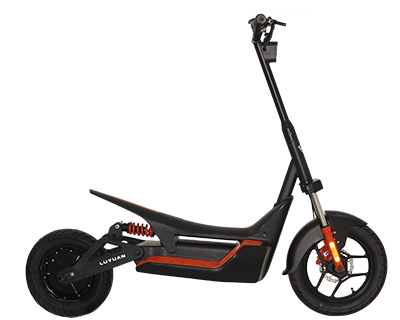
The LUYUAN electric scooter S95 gives that engineering idea a concrete product context. According to LUYUAN's published S95 information, the model uses a 12-inch high-power liquid-cooled motor, with a stated 3,000W rated power and 6,000W peak power. The same source lists 145 N·m of wheel torque and a top speed of nearly 70 km/h.
Those figures are useful because they show the relationship between the motor technology and the product's performance positioning. The liquid-cooled motor is not presented as an isolated component; it sits within a vehicle designed around a particular level of power and riding capability.
At the same time, the figures should be interpreted as published product specifications, not as a promise that every rider will experience identical real-world performance. Road conditions, rider behavior, load, temperature, and other operating factors can affect actual use.
That is why we consider the S95 a useful example of product-level engineering: its liquid-cooled motor forms part of a larger system rather than serving as a single explanation for every aspect of performance.
Technology Should Explain Performance, Not Replace It
For customers comparing electric two-wheelers, technical terminology can sometimes create confusion. “Liquid cooled motor” may sound like a complete performance answer, but it is only one part of the engineering picture.
Motor design needs to work alongside the controller, battery system, electrical architecture, chassis, braking system, and other vehicle components. The S95's published product information, for example, also identifies traction control and braking technologies as part of its performance and safety configuration.
This broader view is particularly useful for buyers speaking with electric scooter manufacturers. Instead of asking whether a vehicle has liquid cooling and stopping there, they can ask what role the cooling system plays within the complete powertrain.
Such questions lead to better technical conversations. They distinguish an engineering feature from a guaranteed outcome and make it easier to understand what the manufacturer is actually designing into the vehicle.
What the S95 Tells Us About Product-Level Engineering
The S95 demonstrates how technology and product positioning can be connected without treating one component as a universal solution. Its liquid-cooled motor is relevant because the model is positioned around higher power and performance, making thermal management an understandable part of the engineering discussion.
For us, that is the more useful way to interpret liquid cooling. The technology provides an engineering foundation for managing motor heat, while the complete vehicle determines how that technology contributes to the finished product.
A buyer evaluating a liquid-cooled motor should therefore look beyond the label. The better questions concern the motor's role in the power system, the supporting electrical architecture, the stated specifications, and the conditions for which the vehicle is intended.
Our S95 connects those ideas at the product level: its published performance specifications sit alongside a liquid-cooled motor and other vehicle systems. That does not eliminate the variables of real-world riding, but it gives customers a clearer way to understand why thermal management is part of the product's engineering story.
Liquid cooling is most meaningful when it can be understood in context. For the S95, the technology helps explain the engineering approach behind a performance-oriented electric two-wheeler rather than serving as a standalone promise. That distinction is essential when turning technical features into a realistic understanding of product performance.




Press: media@luyuan.cn
Telephone: +86-579-82272946
Business: market@luyuan.cn
Telephone: +86-579-82272528
Service: service@luyuangroup.com
Select your country or region
Global
Asia

中文