

S95
M05
S90 (EEC)
MQN8
MKK
S75
S70 Pro (EEC,EMARK)
S70 (EEC)
ZQQ2 (EEC)
DM 01
G01
EB-S1E (EEC)
EB-S1 (CE)
EB-S2 (CE)
EB-2M (CE)
EB-2C (CE)
FB-03 (EN15194)
EB-1M (CE)
KS 01 (EN17128)







Popular searches:
EB-S1
S90
MNK6
EB-S1E
Urban Stop-and-Go Riding: What LUYUAN S95 Buyers Should Pay Attention To


Sep 06,2026
Urban riding does not give an electric scooter much time to settle into one speed. A traffic light appears, the rider slows down, waits, starts again, then brakes for a crossing or another vehicle a few hundred meters later. For this kind of journey, we believe the right question is not simply how much performance a scooter has, but how naturally that performance works through repeated changes in speed.

That distinction matters for anyone considering the LUYUAN electric scooter S95. The specs show what hardware the S95 has. City riding shows how well it works in real stop-and-go traffic. For buyers, the most useful evaluation therefore begins with the rhythm of an actual urban commute.
A City Commute Tests a Scooter Differently
On open roads, performance is easy to feel: acceleration, stability at speed, and available power show up right away. Congested streets create a different test. Most of the journey may involve partial throttle, short braking inputs, low-speed maneuvering, and repeated departures from intersections.
That pattern changes what the rider notices. Smooth responses become more meaningful than maximum output, because the rider has to make small adjustments constantly. A scooter that feels predictable during those adjustments can make a crowded route feel considerably more manageable.
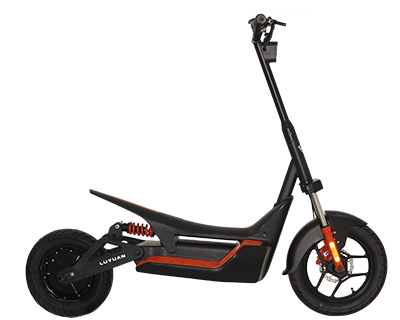
The S95's specifications give buyers useful technical context. Its 12-inch liquid-cooled motor is rated at 3,000 W, with a published peak power of 6,000 W and wheel torque of 145 N·m.
We would not treat those figures as the final answer for urban suitability. Instead, they raise a more practical question: how well does the S95 turn its power into smooth, controlled movement in constant stop-and-go riding?
Every Short Restart Reveals How the S95 Delivers Power
Imagine leaving a red light and finding another queue only a short distance ahead. There is no opportunity to build speed for long. The rider needs enough response to move confidently, but also needs to modulate that response almost immediately.
That is where power delivery becomes part of the riding experience. A buyer should pay attention to how naturally the scooter moves away from a standstill and whether the throttle feels manageable during short bursts of acceleration. Urban riding rewards usable response rather than simply having a large number on a specification sheet.
For us, this is also where the S95's motor specification becomes easier to interpret. Its available torque and peak power provide substantial performance headroom, but the relevant buying question remains how the rider can use that output within the tight spaces and short acceleration windows of city traffic.
Someone comparing the best electric scooter brand should therefore spend less time judging models solely by maximum figures and more time observing their response during repeated starts. A test ride through intersections and low-speed traffic can reveal characteristics that a straight-line acceleration test cannot.
At the Next Light, Stability Becomes More Noticeable
Stop-and-go riding is not simply a sequence of acceleration events. Each acceleration is followed by a controlled reduction in speed, a stop, a balance adjustment, and another departure. The rider is repeatedly moving between different operating states.
That makes stability especially noticeable. A scooter needs to remain composed while the rider manages braking, steering, road positioning, and surrounding traffic at the same time. Small inconsistencies can become much more apparent after dozens of repetitions.
The S95 combines front and rear disc brakes with a CBS linked braking system. It also features a one-touch TCS traction control system according to the manufacturer's published specifications.
For buyers, the significance lies in how these systems contribute to the overall riding experience. Rather than viewing braking and traction technology as isolated features, it is more useful to consider how they support the rider during the repeated transitions that define urban commuting.
Road conditions add another variable. Painted markings, wet patches, uneven pavement, and changing traffic positions can appear within the same trip. A stable-feeling scooter gives the rider a more predictable platform for dealing with those changes.
Repeated Stops Make Thermal Engineering Easier to Understand
Technical terms can seem abstract until the riding situation makes their purpose clear. Liquid cooling is a good example. A motor may move from relatively light operation to a stronger acceleration demand and then return to lower-speed running several times within a short period.
The S95 uses a liquid-cooled motor, making thermal management part of the vehicle's engineering rather than something buyers need to consider only during extreme riding.
That does not mean every stop in city traffic creates an unusual thermal condition. The more useful point is that frequent changes in operating load make the motor's ability to manage heat part of the broader engineering picture.
We recommend that buyers treat this technology as a reason to understand the scooter more deeply, rather than as a standalone marketing phrase. Knowing how the motor is engineered helps explain why two scooters with apparently similar power figures may be designed differently for repeated everyday use.
This technical perspective is particularly useful when assessing the best electric scooter for commuting. Commuting is repetitive by nature, so the engineering behind repeated operation deserves attention alongside immediate riding impressions.
The Right S95 Evaluation Starts With Your Actual Route
A specification sheet cannot reproduce the exact sequence of a daily commute. One rider may travel through a dense commercial district filled with traffic lights, while another may spend most of the trip on wider roads with only occasional stops. The same scooter can therefore feel different depending on how often the rider has to change speed.
We suggest recreating those conditions during an S95 evaluation. Look at the moments that happen repeatedly: pulling away from a junction, slowing behind traffic, stopping smoothly, turning at low speed, and accelerating again after a short wait.
The LUYUAN electric scooter S95 should be assessed through that complete rhythm rather than through one isolated performance test. That way, the motor, braking, traction, and cooling systems can be judged against real city riding.
When people look into the best electric scooter brand, this perspective enables a much more equitable comparison. Rather than fixating on specifications that only look good on paper, buyers should evaluate how predictably the vehicle handles their routine daily movements.
Choosing the best electric scooter for commuting in a stop-and-go environment comes down to recognizing what urban riding repeatedly asks from the vehicle. The S95's technical foundation matters, but its suitability should be judged through control, stability, and confidence across the complete sequence of city riding. That is the perspective we would use when deciding whether the S95 matches a particular urban route.




Press: media@luyuan.cn
Telephone: +86-579-82272946
Business: market@luyuan.cn
Telephone: +86-579-82272528
Service: service@luyuangroup.com
Select your country or region
Global
Asia

中文