

S95
M05
S90 (EEC)
MQN8
MKK
S75
S70 Pro (EEC,EMARK)
S70 (EEC)
ZQQ2 (EEC)
DM 01
G01
EB-S1E (EEC)
EB-S1 (CE)
EB-S2 (CE)
EB-2M (CE)
EB-2C (CE)
FB-03 (EN15194)
EB-1M (CE)
KS 01 (EN17128)







Popular searches:
EB-S1
S90
MNK6
EB-S1E
Delivery Route Demands: How Buyers Can Assess LUYUAN S95 for Frequent Use


Sep 04,2026
A delivery scooter does not have an easy working day. One shift can involve repeated acceleration, frequent stops, changing traffic conditions, carrying goods, and several hours of operation. For buyers considering the S95, the useful question is therefore not whether the scooter sounds impressive on paper. It is whether its characteristics match the route and workload that will be repeated every day.

Defining the delivery task takes priority over judging the vehicle. Real-world conditions—such as distance, stop frequency, charging availability, load weight, and working hours—tell you far more about what works than standard marketing specs.
A Delivery Route Reveals More Than a Specification Sheet
Start by mapping a normal delivery shift from departure to return. Record the total distance, but do not stop there. Note how many delivery points are included, how much time is spent between stops, and whether the rider regularly travels through congested streets, residential areas, or longer connecting roads.
Two routes can cover the same number of kilometers while creating very different demands. A relatively open route with fewer stops may require sustained riding, while a dense delivery area can involve constant starting, braking, turning, parking, and restarting.
Weekly frequency adds another dimension. A scooter used for occasional deliveries has a different workload from one operated six days a week. Buyers should therefore calculate both the distance per shift and the number of shifts expected each week.
That route profile becomes the baseline for evaluating the LUYUAN electric scooter S95. Instead of asking whether it is suitable for “delivery” in the abstract, buyers can ask a much more useful question: does the model fit this particular delivery pattern?
Frequent Stops Change What “Suitable” Means
Delivery work places repetition at the center of vehicle use. The rider may perform the same basic sequence dozens of times during one shift: travel, slow down, stop, unload, restart, and continue. A model that feels appropriate for a normal commute should not automatically be assumed to have the same suitability for this operating cycle.
Rider workload should also be considered. Long hours in the saddle can make seating position, control layout, and overall riding ergonomics more relevant than they would be for a short personal journey. Buyers should examine how the rider actually interacts with the scooter throughout a complete shift.
Load patterns deserve equal attention. A food delivery route, parcel route, and local service route may all have different requirements because the type, size, and frequency of transported goods can vary.
Frequent use therefore needs to be evaluated as a complete operating pattern. The question is not simply how far the scooter travels, but what happens during those kilometers and how consistently the vehicle must repeat the same work.
Daily Distance Should Be Matched to the Charging Routine
Charging should be planned around the delivery schedule rather than treated as a separate technical detail. A rider completing one predictable shift before returning to a charging location has different needs from an operator who remains on the road for most of the day.
Map the expected daily distance against realistic charging opportunities. If the vehicle returns to a base between shifts, that matters. If the rider has no convenient opportunity to recharge during working hours, the required operating margin becomes more significant.
Buyers should also avoid treating a published range as a guaranteed delivery distance. Energy consumption can change with traffic, rider and cargo weight, road conditions, temperature, and riding behavior. A route assessment should therefore leave practical room rather than assume ideal conditions.
For buyers researching a best electric scooter for delivery, this is a particularly important distinction. The “best” model is not necessarily the one with the most prominent performance claim. It is the one whose usable characteristics remain appropriate for the actual route and charging cycle.
Do Not Confuse Performance With Delivery-Fit
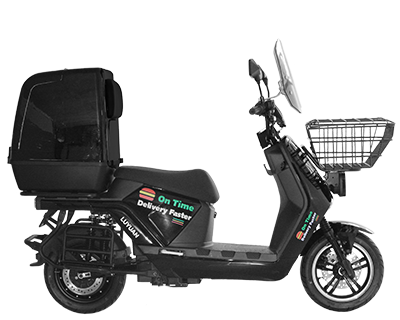
Product classification provides another useful clue. The current product information places S95 within the performance electric-scooter group, while LUYUAN's product range separately identifies the DM 01 under its Delivery category. That means buyers should not assume that S95 is a dedicated delivery model simply because it may be considered for frequent commercial use.
That distinction makes the evaluation more useful, not less. A business considering S95 for delivery should examine the intended route and workload against the model's documented characteristics rather than treating the category label as a shortcut.
The S95 is described by the manufacturer as a luxury e-motorcycle, and independent product information published by the company describes features including a 12-inch liquid-cooled motor and traction control. These specifications can be relevant to a buyer's assessment, but they do not by themselves prove that the model is the optimal choice for every delivery operation.
A disciplined buyer keeps those two questions separate: what the vehicle is engineered to provide, and what the delivery business actually requires.
Turn the Route Into an S95 Purchase Checklist
Before approaching electric scooter suppliers, prepare five pieces of information: average shift distance, longest normal route, approximate stop count, expected cargo pattern, and charging availability. Adding operating days per week makes the assessment even clearer.
Then compare the route with the manufacturer's current product information. Ask which S95 configuration is being offered, what specifications apply to that configuration, and which claims are based on defined testing conditions. This prevents a purchasing team from applying the specification of one configuration to another.
Fleet buyers should also distinguish between a vehicle being technically capable of frequent use and being economically appropriate for the intended operation. Maintenance arrangements, parts support, warranty terms, and supplier responsiveness can influence whether a model works commercially over repeated shifts.
For distributors, the same method can improve customer recommendations. A buyer with short urban routes may have different priorities from one serving longer suburban delivery corridors. Matching the product discussion to those scenarios creates a more credible sales process.
The right way to assess S95 for frequent delivery use is therefore not to ask whether it sounds like a delivery scooter. Start with the route, quantify the repetition, understand charging, define the load, and then compare those requirements with documented vehicle characteristics. We see that route-first method as the most reliable way for commercial buyers to decide whether S95 belongs in a particular delivery operation.




Press: media@luyuan.cn
Telephone: +86-579-82272946
Business: market@luyuan.cn
Telephone: +86-579-82272528
Service: service@luyuangroup.com
Select your country or region
Global
Asia

中文